Wedding Vows: How to Write Them + Original Templates
Complete guide to writing sincere and memorable wedding vows. Tips, structure, mistakes to avoid and original templates to inspire you.
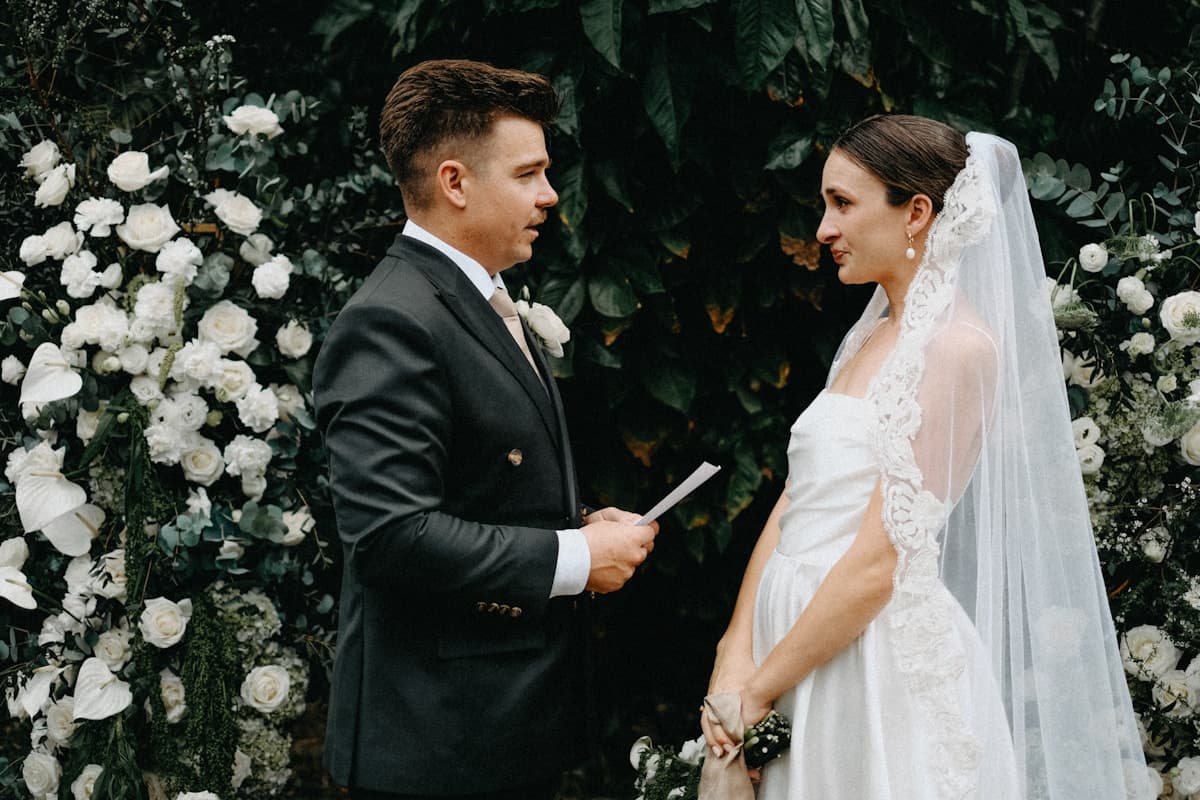
Why wedding vows are the most powerful moment of your ceremony
Among all the moments of a wedding, the vows often remain the most memorable for both the couple and their guests. These are your own words, spoken in front of the person you love, before those who are dearest to you. No best man speech, no reading, no song will ever replace this moment of total authenticity.
Yet the exercise frightens many future brides and grooms. "I'm not good at writing", "I'll cry", "I won't know what to say"... These worries are normal. This guide is here to help you overcome these blocks and write vows that truly reflect who you are.
What's the difference between religious and civil vows?
Religious vows
In a Catholic, Protestant or other religious ceremony, the vows generally follow a formula imposed by the religious ritual. The spouses respond to questions from the officiant ("Do you take X as your lawful spouse?") and recite a codified promise. It's often possible to add a few personal words, depending on the celebrant.
Secular vows
A secular or civil ceremony leaves complete freedom. You write what you want, as long or as short as you like. You can be funny, poetic, emotional, or all three at once. It's this freedom that makes the exercise both exhilarating and daunting.
How far in advance should you write your vows?
Ideally, start thinking about your vows 2 to 3 months before the wedding. This gives you time to jot down ideas as they come, draft a first version, let it rest, and then refine it.
Avoid waiting until the last week: the pressure of final preparations, fatigue and stress are not conducive to writing a sincere and balanced text.
The ideal structure for wedding vows
There's no single blueprint, but here's a structure that works in the vast majority of cases:
1. The opening (1-2 sentences)
Start with something that captures attention. An anecdote, an image, an emotion. Avoid overly generic openings like "Since the first day I saw you..."
2. The "us" - your shared story (2-4 sentences)
Briefly evoke what connects you, a strong memory, what you've built together. Anchor your vows in your real history rather than generalities about love.
3. What you love about the other person (2-3 specific qualities)
Be specific. "You're kind" doesn't move anyone. However, "you're able to brighten any difficult day with your way of..." is a detail only you can say.
4. Your promises (the heart of the vows)
This is the most important part. Formulate 3 to 5 concrete, realistic and personal promises. Avoid impossible promises ("I will never be angry with you") in favor of sincere commitments.
5. The conclusion
End with a strong sentence that will be remembered. A direct declaration of love, a touch of humor if that's your style, or a word that symbolizes your relationship.
How long should wedding vows be?
The ideal duration is between 1 and 3 minutes when spoken aloud, or approximately 150 to 400 words. Less than that can seem rushed. More than that, you risk losing the guests' attention (and crying for too long).
If both partners are reading their vows, think about coordinating on length so there isn't an obvious imbalance.
The most common mistakes
Being too vague: "I love you more than anything" says nothing unique about your relationship. Look for what's specific to the two of you.
Trying too hard to be perfect: By polishing the text too much, some people lose their natural voice. Your vows should resemble you, not a 19th century poem.
Copying what you've seen online: Vow examples on the internet can inspire, but copying a template as-is shows. Make what you read your own.
Not practicing out loud: A text that seems short when read can take much longer when spoken aloud, especially with emotions. Practice several times, stopwatch in hand.
Promising what you can't keep: Vows should be sincere, not perfect. Avoid promises of absolute eternity in favor of concrete, human commitments.
How to go about it: the 5-step method
Step 1: Ask yourself the right questions
Before writing a single line, take 20 minutes to answer these questions in writing:
- What's the first memory that comes to mind when I think of you?
- What have you changed in my life that I wouldn't have expected?
- What quality do I admire most in you?
- What do I want us to build together?
- If you weren't here in 10 years, what would I miss most?
Step 2: Write without filtering
Take your answers and write a first draft without censoring yourself. Don't look for the perfect formula. Let whatever comes, come. You can always sort it out later.
Step 3: Select and structure
Reread your first draft and underline the passages that truly move you. Build your final text from these fragments using the structure suggested above.
Step 4: Have a trusted person read your text
Not to correct it, but to tell you if it sounds like you. A close friend who knows you well can tell you if your voice is there or if you're playing a role.
Step 5: Read aloud at least 5 times
This is the step everyone skips and it's the most important. Read standing up, as if you were there. You'll find the words that trip you up, the passages that are too long, the phrasings that ring false. Correct, and reread.
Vow templates to inspire you
Template 1: Tender and sincere tone
"I remember the first time I understood you were someone exceptional: it was [concrete anecdote]. That day, I knew I was lucky.
Since then, you've taught me [something concrete]. You've shown me that [value or worldview]. And you continue, every day, to surprise me.
Today, in front of our loved ones, I promise you to [promise 1], to [promise 2], and to always [promise 3]. I also promise to be there when things aren't going well, to be proud of you even when you doubt yourself, and to choose this life with you, again and again.
I love you."
Template 2: Light tone with a touch of humor
"It's been [X] years that we've been together, and I can tell you one thing with certainty: I didn't know what I was getting into. [Funny anecdote or inside reference]
But seriously. What you've brought me is [sincere quality]. And for that, I'm grateful to you every day.
Here are my promises: to support you in your projects even the craziest ones, to never miss a [ritual you share], and to keep [nice habit you both have].
And above all: to love you for real. Not movie love, but ours. The kind that lasts."
Template 3: Poetic and literary tone
"There are encounters that resemble happy accidents. Yours is one of them.
I wasn't looking for someone like you - and you're precisely who I found. Someone who [poetic description of a specific quality].
Today, I make you the simplest and most ambitious promise there is: to be present. In the big moments and in the ordinary ones. In joy and in storms. Entirely there, for you.
You are my choice. And I make this choice with joy."
Should you keep your vows secret until the wedding day?
This is a frequent question. Tradition would have each person keep their vows to themselves to preserve the emotion of discovery. In practice, many couples choose to show each other their vows in advance to avoid imbalances in length or tone.
There's no right answer. If you're anxious about an imbalance, share your texts. If you prefer total surprise, keep your vows secret and trust your partner.
Managing stress when reading your vows on the day
Even people comfortable with public speaking have shaking legs when the moment comes to read their vows. Here are some practical tips:
- Print your vows in large format (font size 16 minimum) to avoid squinting at a tiny piece of paper.
- Breathe before you start: one deep breath, a look toward your partner, then begin.
- Allow yourself to pause if emotions surge. One pause and a breath, and you're off again.
- Don't read with your eyes fixed on the paper: look up regularly toward your partner. It's to them that you're speaking.
- Remember that crying is not a failure: on the contrary, it's proof that you're authentic. Your guests will love you even more for it.
Organize your wedding and share your vows with wondr wedding
Writing beautiful vows is a key step, but organizing everything else is just as important. With wondr wedding, create your personalized wedding website for free: share the day's program, manage your RSVPs online, track your budget and keep your guests informed until the big day.
A wedding website created in minutes, so you can focus on what matters most - like writing those vows that will last forever.
Frequently asked questions
How do you write your wedding vows?
Start from concrete anecdotes rather than abstract ideas: a defining moment in your story, a quirky habit that makes you laugh, a quality you admire. Write 3 or 4 short paragraphs, read them aloud, then cut anything that sounds rehearsed.
How long should wedding vows be?
Between 2 and 4 minutes max (i.e. 300–500 words read out). Beyond that, your partner and your guests lose focus. Agree on rough lengths upfront to avoid one of you reading for 5 minutes and the other for 30 seconds.
Can you read your vows on the day?
Yes — it's actually recommended: emotion often wipes your memory. Print them on nice paper or use a small notebook prepared in advance — it looks better than a phone and you avoid the stress of a dying battery.
Should both partners write their vows together?
No, the convention is to write yours separately to keep the surprise. But agree on the format upfront: length, tone (humour vs. emotion), structure (3 promises, open letter, etc.). That avoids a big imbalance on the day.
What if you can't manage to write your vows?
Start by answering 3 simple questions: “what made me fall in love?”, “what do you bring to my daily life?”, “what promise do I want to make for the next 50 years?”. Your answers already contain the raw material of your vows.
Ready to create your wedding website?
Centralise every practical detail for your guests in 5 minutes — RSVP, directions, accommodation, schedule. Free, elegant, mobile-first.
Create my site for free